Reference C · Safety & incident data
Plug-in
solar safety
What the actual incident and statistical record shows.
Safety questions around plug-in solar tend to get waved off entirely, or treated as inherently reckless. Neither response provides a real answer. This page lays out what's documented, starting with the broad statistical picture, then the one real incident worth knowing about, then the more detailed technical and regulatory questions underneath it.
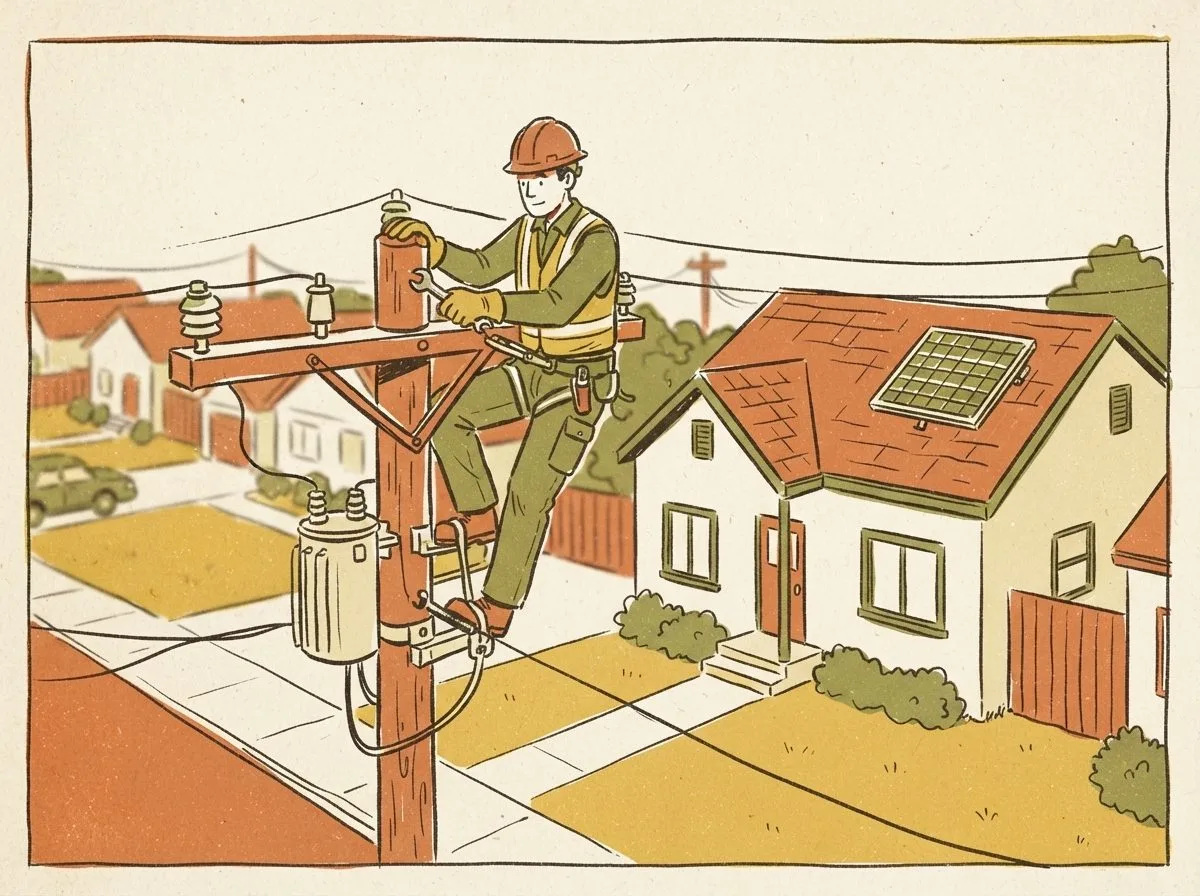
Most of what's documented here comes from Germany, which has the largest, longest-running plug-in solar market globally, with over a million registered systems and years of real-world track record, making it the best available dataset on how these systems actually perform outside a lab.
According to the Fraunhofer Institute for Solar Energy Systems (ISE), one of Germany's leading research institutes, only about 0.006 percent of all solar (PV, photovoltaic) installations in the country cause a fire with significant damage. Over the past 20 years, the total number of such cases hasn't even reached triple digits, against several million installed systems nationwide. Current data from German fire brigades and insurers backs this up directly: balcony solar doesn't rank among the causes of household fires they track, and reported incidents remain vanishingly small relative to the installed base. Industry and consumer bodies, including the German Solar Energy Society (DGS) and the German electrical engineering association (VDE), put the fire risk of a compliant system below that of a clothes dryer or a television.
None of that means zero risk. It means the base rate is low, and the incidents that do happen tend to be traceable to something specific rather than the technology itself.
Bottom line: documented fire risk from a compliant system runs below that of a clothes dryer, with fewer than 100 serious incidents in 20 years against millions of installs.
The one documented major incident
In March 2024, a residential system in Lower Saxony, Germany caught fire two weeks after installation. The system paired a 1.78kW plug-in solar array with a 2.4kWh lithium iron phosphate battery. The fire was brought under control within two hours but destroyed the home's heating system and caused enough damage that the homeowner had to relocate temporarily.
The investigation ruled out battery cell failure directly, no swelling or deformation was found in the cells. Instead, it traced the fault to the maximum power point tracking (MPPT) connector, which showed abnormal heat buildup. Log data confirmed a network communication fault that left the microinverter in a compromised operational state for roughly 10 hours before a short circuit at the MPPT connection triggered the failure.
It is worth emphasizing that this system had a battery attached. It's the standout documented incident from this research, and it isn't a case of a bare panel-and-microinverter setup plugged into an outlet.
Bottom line: one battery-attached system caught fire in Germany in March 2024, traced to an MPPT connector fault, not a battery failure.
Why the battery distinction matters
Germany's dedicated safety standard for plug-in solar, DIN VDE V 0126-95, took effect in December 2025, and it explicitly covers systems without energy storage. Battery-integrated and hybrid systems are excluded from it entirely and are being handled under a separate standard still in development. Germany's own regulatory body has functionally split this into two different risk categories: a simpler one for panel-plus-inverter setups, and a more complex one for anything with a battery attached.
The backfeed question, which is closer to settled than open
The safety concern that gets cited most often, in some form, is backfeed: a device continuing to send power into a line during a grid outage, potentially endangering a utility crew working on what they believe is a dead line. On this specific question, the data is unusually clean. Germany offers a real-world test case: with more than a million small balcony solar units registered and deployed, no lineworker safety incidents have been reported, apart from cases of deliberate tampering. A formal risk analysis conducted under the International Energy Agency placed the annual risk of shock from residential solar islanding at less than one in one billion under worst-case conditions, roughly a thousand times lower than the odds of being struck by lightning. This is the mechanism anti-islanding protection exists to prevent, and by this data, it's doing its job. Anti-islanding is a standard feature already built into microinverters like the APsystems EZ1-LV used in this project.
Bottom line: no lineworker safety incidents across 1M+ deployed systems in Germany; estimated shock risk is under 1 in a billion.
Technical concerns worth knowing
Low incident rates don't mean there's nothing to actually understand about how these systems interact with a home's existing wiring:
-
Circuit overload isn't caught by a standard breaker
Solar panels inject power downstream of a circuit's breakers, so a traditional breaker has no way to detect or respond to the added load. Left unaddressed, this can damage equipment or start a fire over time.
-
GFCI protection can be compromised
Outdoor ground-fault outlets normally cut power when they detect wet conditions, protecting against shock. That protection may not function correctly when power is flowing backward into the outlet from a panel instead of the normal direction.
-
A "disconnected" plug can still be live
Unlike an ordinary appliance, a solar panel's plug can remain electrically conductive for up to two seconds after being unplugged, if the panel is still receiving light. Worth knowing before assuming a disconnected cord is automatically safe to touch.
-
Don't stack systems on one circuit
Daisy-chaining multiple plug-in panels through an extension cord, or connecting more panels to a single circuit than the manufacturer recommends, raise overload risk.
One widely repeated claim is worth treating skeptically: that a common four-panel setup can exceed a standard outlet's safe continuous load. That framing usually conflates a panel's raw DC peak wattage with the system's actual AC output, which regulation already caps well below that (600 to 800 watts in Germany, regardless of panel rating). The inverter is the limiting factor, not the panel's nameplate number.
Bottom line: the real risks are circuit overload, compromised GFCI protection, briefly-live plugs after disconnect, and stacking too many panels on one circuit — not fire headlines.
Where regulation stands
As adoption has grown quickly across Europe, multiple countries have opened their own conversations about how to keep pace on safety standards, interconnection rules, and grid-stability questions, sometimes in tension with EU-level policy that's been actively encouraging plug-in solar deployment. None of that amounts to a consensus that these systems are unsafe. It reflects an industry that's still catching up its formal standards to adoption that outpaced them, the same basic story running through the legal side of this whole project.
Bottom line: rules are catching up to adoption. That's not the same as evidence the technology is unsafe.
The US experience so far
Utah legalized plug-in solar first, in March 2025, and no documented safety incidents have surfaced since, though adoption has stayed limited enough that the sample size is still small. Notably, the certification didn't exist yet when the law passed: Utah's legislation is what prompted UL to develop a plug-in-specific safety standard in the first place, starting with a hazard white paper before building out the actual requirements.
The same lineworker safety concern gets raised here too, enough that utilities have used it to delay votes on similar bills in at least five states. It's the same backfeed risk covered above, and the data doesn't currently support it as the primary driver, though utilities may have other reasons for caution beyond what's stated publicly.
Bottom line: Utah legalized plug-in solar in 2025; no safety incidents reported so far, though adoption is still small.
- Fraunhofer Institute for Solar Energy Systems (ISE) — PV fire risk assessment data, cited via priwatt.de and photovoltaik.info
- PC-WELT — "Brandrisiko Balkonkraftwerk: Zahlen, Ursachen, Realität" (2026)
- Deutsche Gesellschaft für Sonnenenergie (DGS) and VDE — cited via photovoltaik.info
- VDE — DIN VDE V 0126-95 standard details, via solaranlage-ratgeber.de and Verbraucherzentrale.de
- pv magazine / ESS News — Lower Saxony balcony solar and battery fire incident, March 2024
- Southern Alliance for Clean Energy (SACE) — "Plug-In Solar Is Safer, But The Regulations Don't Reflect That," lineworker safety data and IEA islanding risk analysis
- MIT Technology Review — "The balcony solar boom," UL Solutions safety considerations
- IEEE Spectrum — "Plug In Balcony Solar Power Moves from Hack to Household," UL 3700 development
- Netherlands Standardization Institute (NEN) — cited via IO+ (ioplus.nl)
- Energy Box — "Plug-in PV vs EU Policy: Germany Sparks Controversy" (2025)
- KUTV — "Utah led the nation in legalizing plug-in solar" and related coverage (2026)
- UPR / Utility Dive — Utah HB 340, UL's plug-in solar white paper and certification development, utility pushback on lineworker safety (2026)