Reference E · Panel sourcing · Updated September 2026
Sourcing panels
for plug-in solar
in the US
Finding good, affordable, and lightweight yet durable panels in the USA is a pain in the ass. Here's why.
Picking a microinverter is a matter of checking a datasheet and downloading an app. Finding a panel that actually works with it is a genuinely harder problem in the US right now — a market problem, not a technical one. The panels most readily available here simply weren't built with plug-in solar in mind.
Why the market looks the way it does
Search "flexible solar panel" or "portable solar panel" on Amazon, Home Depot, or Lowe's, and the results are overwhelmingly one thing: lightweight, 12V-nominal panels built for RVs, boats, and off-grid battery charging. Packaging and freight costs, not electrical performance, drive that dominance: flexible, low-voltage panels box up small and ship cheap, and that alone is enough to crowd DIY-facing retail shelves, whether or not they're the right fit for a grid-tied microinverter.
Meanwhile, American panel manufacturers are mostly building for the opposite end of the market entirely: large-format modules sized for full residential or utility-scale arrays, not small, plug-in-friendly panels a single person can carry up a ladder. There's very little domestic manufacturing aimed at this specific niche.
There's a regulatory reason on top of the shipping one. In March 2024, the U.S. Department of Commerce revoked antidumping and countervailing duty tariffs on a specific category: "off-grid small portable" crystalline silicon panels of 200 watts or less, with an integrated handle, a kickstand, and a barrel connector on at least 3 meters of wire. That's a precise description of a camping or RV solar kit. A panel built for wall or balcony-rail mounting doesn't have a handle or a kickstand and doesn't use a barrel connector, so it doesn't qualify for the carve-out and stays fully exposed to the tariff. The panels that are tariff-exempt and the panels that are voltage-compatible with plug-in microinverters turn out to be almost entirely different products.
The company that asked for this specific carve-out was Shenzhen Hello Tech Energy Co., Ltd., the parent company of Jackery, the portable power station and solar generator brand. Hello Tech requested the review in August 2022, and the exclusion criteria Commerce ultimately finalized read almost like a spec sheet for Jackery's own panel line: a handle, a kickstand, an 8mm barrel connector, 200 watts or less. Domestic solar manufacturers, represented by the American Alliance for Solar Manufacturing, didn't fight the request. Their members build utility-scale and residential rooftop modules, not camping-style panels, so a carve-out this narrow cost them nothing to leave alone. Whatever the merits of Hello Tech's case, the exclusion wasn't shaped with plug-in solar users in mind. It was shaped around one company's own product line, and the panels that happen to clear US customs duty-free are, unsurprisingly, the same panels that company already sells.
This created a gap in the market: a panel that qualifies for the exclusion pays 0% in duties, while a 24V-nominal panel doesn't and gets hit with whatever rate applies wherever it was assembled. Most of that assembly has shifted to Cambodia, Malaysia, Thailand, and Vietnam since the original China-specific tariffs, and Vietnam's own country-wide rate alone runs 271%, with individual producers assessed far higher. A rate anywhere in that range can double or triple a panel's landed cost before it ever reaches a shelf, enough to keep retailers out of the DIY solar market altogether.
Small consumer orders directly from an overseas seller used to have a way around all of this, the same way it was for cheap goods on fast-fashion and shopping apps: a package under $800 could clear US customs duty-free with barely any paperwork, under a rule called "de minimis" entry. That rule is gone now, first for China and Hong Kong shipments in mid-2025, then everywhere else a few months later, made permanent by regulation in mid-2026. Now, a panel ordered directly from overseas goes through the same formal customs process as any commercial import, duties included, so costs are meaningfully higher.
The actual electrical problem
Most plug-in microinverters need a panel with a meaningfully higher voltage than a standard 12V-nominal RV or marine panel provides. The APsystems EZ1-LV, for example, has a 27 to 45V full-power window (26 to 60V MPPT). A typical 12V-nominal flexible panel runs a Vmp around 17 to 21V, well under that floor.
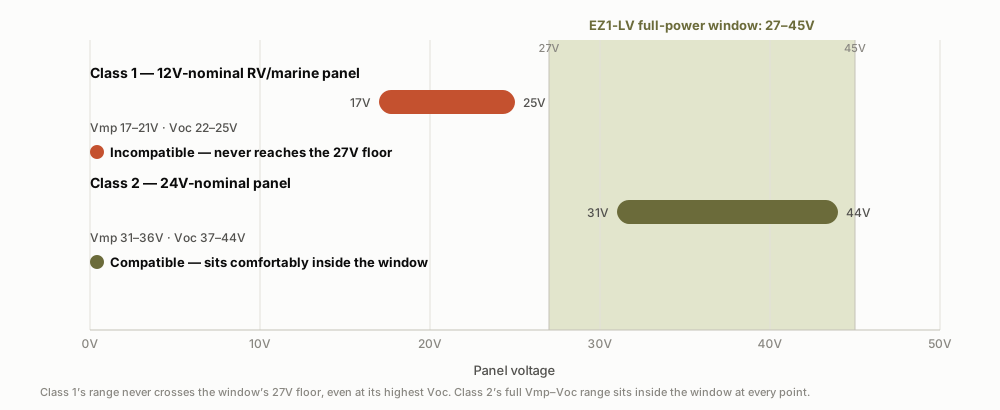
Panel types can be split into two categories, and the picture changes a lot depending on which microinverter is involved:
Standard 12V-nominal RV/marine panels
Voc typically lands around 22 to 25V, Vmp around 17 to 21V. This class doesn't work with the EZ1-LV at all. Against a wider-window inverter like Hoymiles' HiFlow Pro LV (16 to 60V, 22V start-up), this class becomes technically viable, but only with a thin margin, Voc clears the 22V start-up threshold by roughly 2 to 3 volts, which is not a lot of room to lose to ordinary hot-weather voltage droop on a sun-exposed roof or wall. This is the class flooding search results everywhere.
24V-nominal panels
Voc typically runs 37 to 44V, Vmp around 31 to 36V, roughly double the 12V class. This range comfortably clears a wide-window inverter and sits inside a narrower one like the EZ1-LV as well. In other words: this is the class that actually works broadly, but it's a smaller, less heavily marketed slice of the DIY panel market than the 12V category.
What to actually watch for
-
Certification is inconsistent across this whole category. Most of the 24V-nominal panels worth considering are CE and IEC certified, not UL certified, a distinction buyers should weigh for themselves against their own local code and insurance requirements.
-
None of these pairings are manufacturer-endorsed for grid-tie use. A 24V-nominal panel working electrically with a plug-in microinverter comes from reading published voltage specs against a microinverter's published MPPT window, not from any manufacturer marketing, testing, or endorsing that pairing themselves.
-
Weight and shipping format still matter, especially for anyone without a truck or a helper. A 200W rigid panel in the 23 to 24 lb range ships and handles very differently than a flexible panel under 10 lbs, even when both are electrically compatible.
For specific panels, current pricing, and what's actually in stock right now, see the shopping guide.
- Hoymiles HiFlow Pro LV series datasheet (hoymiles.com), confirming 16–60V MPPT window and 22V start-up voltage
- APsystems EZ1-LV official CSA certificate documentation, confirming a 26–60V MPPT range and 27–45V full-power window
- Manufacturer product pages and datasheets for panels evaluated across both voltage classes: Renogy, Rich Solar, Battle Born Batteries, and general market survey of WindyNation, ECO-WORTHY, HQST, ACOPower, and Newpowa listings
- Federal Register, "Crystalline Silicon Photovoltaic Products From the People's Republic of China: Preliminary Results of Changed Circumstances Reviews" (March 7, 2023), identifying Shenzhen Hello Tech Energy Co., Ltd. as the party that requested the off-grid small portable panel exclusion on August 8, 2022, and quoting the exclusion's handle/kickstand/barrel-connector criteria
- Federal Register, "Crystalline Silicon Photovoltaic Cells, Whether or Not Assembled Into Modules, From the People's Republic of China: Final Results of Changed Circumstances Reviews, and Revocation of the Antidumping and Countervailing Duty Orders, in Part" (March 20, 2024), finalizing the Hello Tech-originated exclusion and recording the American Alliance for Solar Manufacturing's non-opposition
- Federal Register, "Crystalline Silicon Photovoltaic Cells... Final Results of Changed Circumstances Reviews" (July 24, 2025), documenting the separate, narrower 20-watt exclusion requested by Lutron Electronics in August 2024 for panels used in motorized window-shade automation
- PRNewswire/Nasdaq, "CBAK Partners with Hello Tech, the parent company of Jackery" (2024), confirming the Hello Tech–Jackery parent company relationship
- Solar Power World, "Commerce reveals antidumping tariff rates on Southeast Asian solar panels" (December 2024), for current AD rate ranges by country
- Commerce Department final AD/CVD determination on solar cells from Vietnam, Malaysia, Thailand, and Cambodia (April 2025), confirming Vietnam's 271.28% country-wide antidumping rate
- ING, "What does it mean to have up to 3,521% US tariffs on Southeast Asian solar imports" (2025), for the upper-bound penalty rate context
- Executive and CBP regulatory actions suspending the Section 321 "de minimis" entry exemption (China/Hong Kong, May 2025; globally, August 2025; suspension made indefinite by regulation, June 2026)